

for individuals with Afro-textured hair, using advanced extraction
techniques and specialized equipment to safely harvest curved and coiled
hair follicles. Specialized tools and techniques are required for Afro
hair to minimize transection rates that can reach 80% with conventional
methods developed for straight hair. Afro hair transplants cost between
$3,000 and $25,000 depending on location and achieve success rates above
90% when performed with proper techniques.Afro hair transplants address
unique challenges posed by curved follicular structures that sit at acute
angles beneath the scalp surface. The C-shaped or helical configuration of
Afro-textured hair follicles requires surgeons to use specialized curved
punches, larger diameter instruments, and modified extraction protocols to
prevent follicle damage during harvesting. Despite lower average hair
density compared to straight hair, the curly morphology creates excellent
coverage and fullness after transplantation.The procedure effectively
treats androgenetic alopecia, traction alopecia, central centrifugal
cicatricial alopecia (CCCA), and scarring from chemical treatments or
tight hairstyling practices. With proper technique, advanced equipment,
and experienced surgeons, individuals of African descent can achieve
natural, permanent hair restoration results.
Key points:
- Afro hair transplant uses specialized techniques for curved, coiled
hair follicles - Costs range from $3,000 to $25,000 depending on country and technique
- Success rates reach above 90% with proper methods
- Maximum 4,500 grafts can be transplanted in single session
- Procedure takes 6-8 hours on average
- Requires larger punch sizes (1.3mm-1.6mm) than straight hair
- Works for scalp hair, beard, and body hair restoration
- Test grafting recommended to assess keloid risk
What is a hair transplant?
A hair transplant is a surgical procedure that moves individual hair
follicles from areas resistant to balding (donor site) to areas
experiencing hair loss (recipient site) on a patient’s scalp. The
procedure falls under reconstructive plastic surgery and provides a
permanent solution for various types of hair loss.
What is Afro hair transplant?
Afro hair transplant is a specialized hair restoration technique that uses
modified extraction methods or equipment designed to safely harvest and
implant the curved, coiled, or helical hair follicles characteristic of
Afro-textured hair. Unlike standard hair transplants performed on straight
hair, Afro hair transplants must account for the unique curl pattern where
follicles can curve at diameters of 3mm-4mm beneath the skin. To account
for this curve, hair transplant surgeons must use modified techniques or
equipment to safely harvest and implant Afro-textured hair.
How much does Afro hair transplant cost?
Afro hair transplants cost between $3,000 and $25,000 depending on the
country, technique, and number of grafts. In Western countries such as the
USA, UK, and Germany, the average cost ranges from $15,000 to $25,000. In
countries like Turkey, Afro hair transplants cost around $2,000 to $5,000
on average. Hair Transplat Cost.
Are Afro hair transplants more expensive?
No. Although Afro hair transplants require specialized expertise, tailored techniques, and experience with curly hair characteristics, they are generally priced the same as hair transplants for straight hair. Reputable clinics do not usually charge extra based solely on hair type or ethnic background.
What is the success rate of Afro hair transplant?
The success rate of Afro hair transplant with specialized techniques is
above 90% when performed by experienced surgeons using proper equipment.
Studies show that maximum transection rates of less than 10% can be
achieved with skin-responsive FUE devices and proper technique, compared
to transection rates (hairs los during harvesting and graft preparation)
of 6%-80% reported with conventional methods developed for straight hair.
The success of Afro hair transplants depends on multiple factors including
the surgeon’s experience with Afro-textured hair, proper punch size
selection, extraction angle accuracy, skin thickness assessment, graft
preparation protocols, and the hair’s degree of curliness.
How does Afro hair transplant work?
Afro hair transplant works through a specialized three-phase process of
assessment, extraction, and implantation designed specifically for curved
follicular structures. The procedure uses the FUE (Follicular Unit
Extraction) method with modifications for Afro-textured hair
characteristics. During the hair & scalp analysis phase, patients are
assessed based on their skin thickness and hair texture. As a general rule
of thumb, as the skin gets thicker and the hair gets more coiled and
coarse in texture, more modifications are required to safely transplant
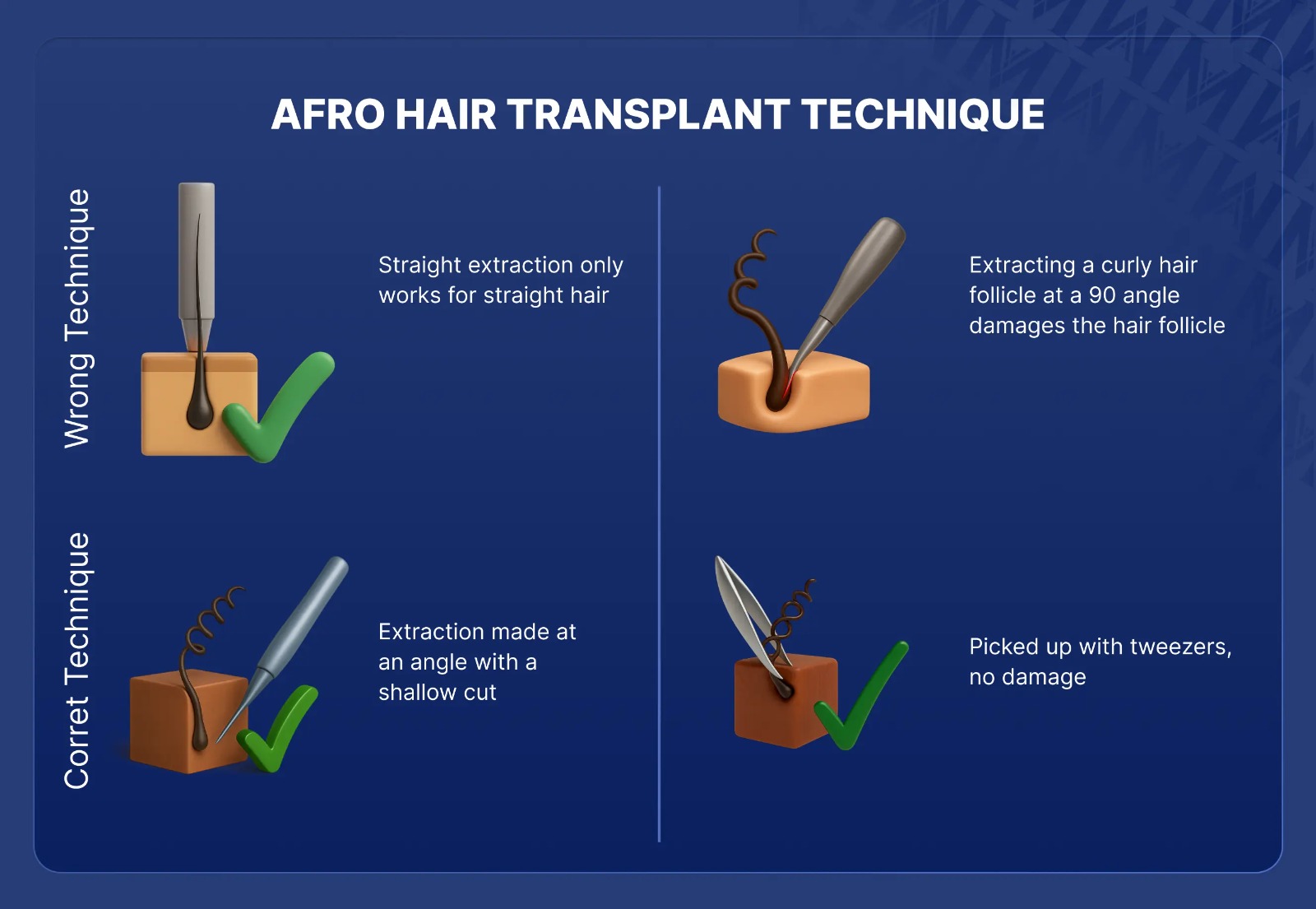
the hair. During extraction, specialized punches enter the scalp at acute
angles matching the hair’s exit angle to follow the curved follicular
path. Grafts are extracted to mid-dermis depth only, then gently removed
with forceps to prevent transection of the curved lower portion.
The Afro hair transplant process follows these steps:
- Pre-op tests, hair and scalp analysis
- Hairline design customized for African features
- Shaving the donor area
- Local anesthesia administration
- Follicular unit extraction with specialized curved or
skin-responsive punches - Graft preparation using curved DermaBlades
- Recipient site creation
- Graft implantation at proper angles
- Recovery and post-op instructions
- First wash and healing monitoring
How long does Afro hair transplant take?
An Afro hair transplant takes about 6-8 hours on average. The duration
may be longer than standard hair transplants due to the increased care
required during extraction to prevent transection of curved follicles,
careful angle assessment for each graft, and meticulous graft
preparation using curved blades.
Can Afro hair transplant be done with body hair?
Theoretically, Afro hair transplants fom body hair to the scalp is
possible but will have poor results as the body hair texture is
significantly different from the hair texture on the scalp. A more
suitable approach would be beard to head hair transplant.
Does Afro hair transplant work for beard transplants?
Yes, Afro hair transplant techniques works for the transplantation of
scalp hair to the beard area.
Does Afro hair transplant work for eyebrow transplants?
Theoretically, eyebrow transplant with Afro hair texture is possible but
results may not be satisfactory. The biggest challenge of an Afro
eyebrow transplant is to find hairs similarly textured to the eyebrows
on the patient’s body.
What makes Afro hair transplant different from other hair transplants?
Afro hair transplant differs from standard hair transplants in tool
requirements, extraction techniques, and equipment specifications
necessary to safely harvest curved follicular structures. The
fundamental difference lies in the C-shaped or helical configuration of
Afro-textured hair beneath the scalp surface.
Key differences include:
- Specialized punches: Skin-responsive flared punches, curved
non-rotary punches, or textured rotating punches should be used to
avoid damaging hair follicles - Larger punch diameters: If special punch tips are not available,
surgeons should use larger sizes of standard punches - Modified extraction angles: Must match acute entry angles to
follow the curved follicular path of Afro hair follicles - Shallower incisions: During extraction and implantation, incisions
are made shallower to accommodate the curl pattern. - Curved graft preparation tools: Using curved or flexible blades
during graft preparation to reduce transection rates - Longer procedure time: Additional care required increases surgery
duration - Lower density with more coverage: More coverage can be achieved
with less hair - Higher keloid risk: People of African descent are more likely to
develop keloid scarring, which needs to be accounted for
What is the maximum number of grafts possible with Afro hair
transplant?
The maximum number of grafts possible in a single Afro hair transplant
session is 4,000 grafts. This number may seem low, but patients of
African descent can achieve satisfactry results with good coverage at
lower graft counts.
How are Afro hair transplant grafts counted?
Afro hair transplant grafts are counted as follicular units containing
1-4 individual hair follicles. Individuals of African descent typically
have 3 follicles per follicular unit on average, compared to 2 in
Caucasian individuals, which results in higher total hair counts despite
lower follicular unit density.
How is donor area capacity calculated for Afro hair transplant?
Donor area capacity for Afro hair transplant is calculated during
pre-operative microscopic scalp analysis that evaluates follicular unit
density, hair caliber, scalp laxity, and the degree of follicular
curvature.
How is the hairline designed for Afro hair transplant?
The hairline design for Afro hair transplant follows masculine or
feminine aesthetic principles appropriate for African facial features.
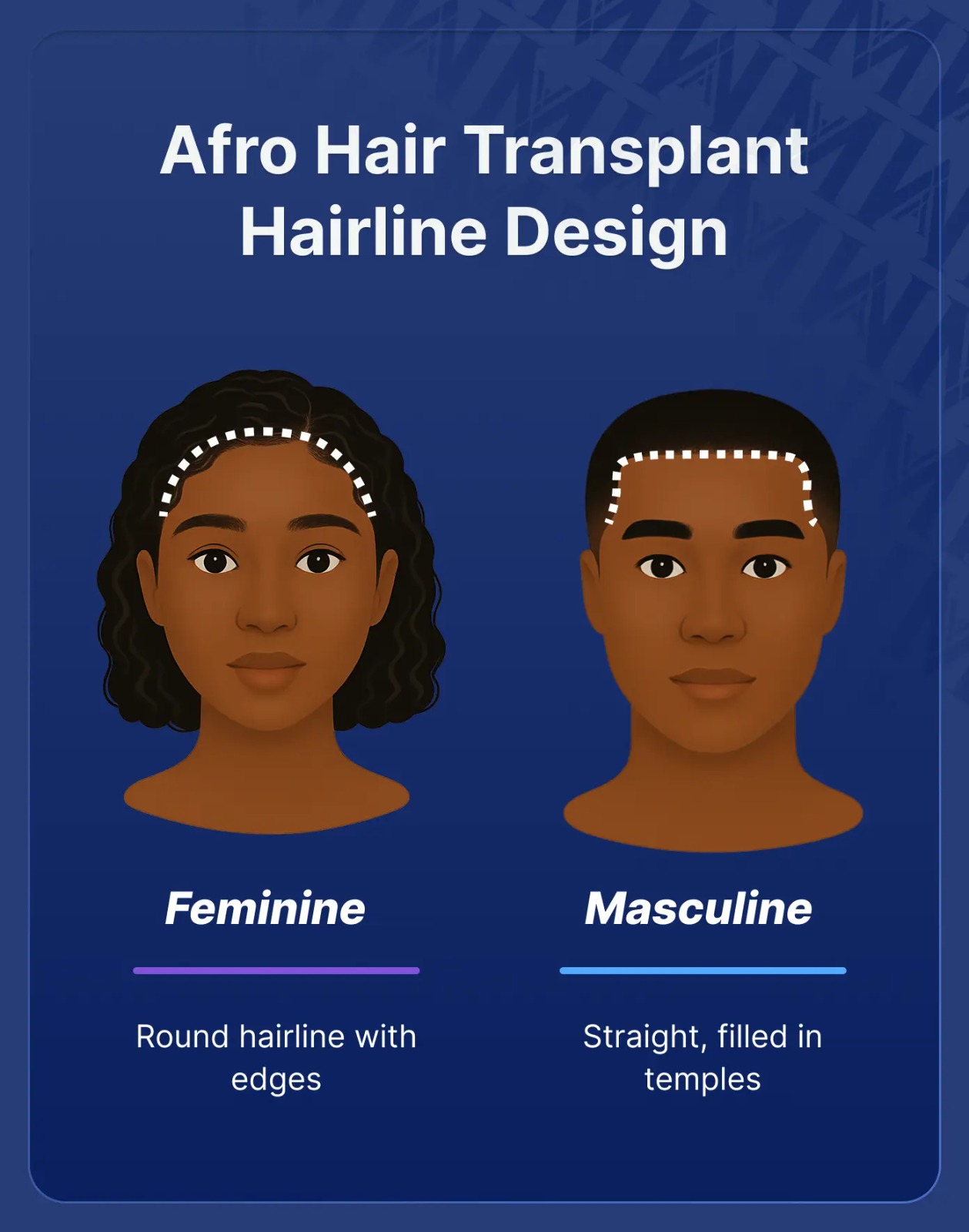
For men, the hairline is designed straight across or with minimal
temporal recession, typically positioned 8-10cm from the glabella. For
women, a lower, rounded hairline with soft irregularity is created to
mimic natural edges.
Get a Free Hair Analysis
Find out how many grafts you need — for free. Our team will get back
to you in minutes.
Single-hair grafts are placed along the hairline edge at acute angles
(10°-20°) to create a natural, feathered appearance, with 2-3 hair
grafts positioned behind for density.
Who is a good candidate for Afro hair transplant?
You are a good candidate for Afro hair transplant if you:
- Are between ages 18-65
- Have stable hair loss pattern (Norwood 2-6)
- Have sufficient donor hair quality and density
- Are in overall good health without active scalp conditions
- Have realistic expectations about results
- Do not have active inflammatory scalp disease
- Have no personal or family history of keloid formation
Do you need to shave your hair for Afro hair transplant?
Yes, you need to shave your recipient area for proper extraction of Afro
textured hair. The recipient are may be left long depending on your
case.
What is the best age for Afro hair transplant?
The best age for Afro hair transplant is between 25 and 60. Between
these ages, most individuals have established hair loss patterns
suitable for surgical planning, adequate wound healing capacity, and
realistic expectations about long-term outcomes.
Which hair loss types can Afro hair transplant work for?
Afro hair transplant can work for restoring hair loss from:
- Androgenetic alopecia (male and female pattern baldness)
- Traction alopecia (if hair loss is permanent)
- Central centrifugal cicatricial alopecia (CCCA) (if inactive for
9-12 months) - Frontal fibrosing alopecia (if inactive and stable)
- Scarring from chemical treatments or burns
- Failed previous hair transplants
- Receding temples and hairline
- Crown thinning
Does Afro hair transplant work for women?
Yes, Afro hair transplant works effectively for women experiencing
female pattern hair loss, traction alopecia from tight hairstyles
(braids, weaves, extensions), or inactive CCCA. Women of African descent
are excellent candidates when they have stable donor hair and realistic
expectations.
Can Afro hair transplant be done with thin donor hair?
Thin donor hair is not recommended for Afro hair transplant because
miniaturized follicles have lower survival rates and are more
susceptible to transection during extraction due to reduced structural
integrity.
What are the alternatives to Afro hair transplant?
The alternatives to Afro hair transplant include:
- FUT (Follicular Unit Transplantation): Strip harvesting avoids
curved extraction challenges but leaves a linear scar, which
clashes with hair styling practices preferred by people with Afro
hair textures and is more likely to develop a keloid scar, making
it a less than ideal for Afro hair transplants. - Medical therapy: Minoxidil 5% and finasteride for androgenetic
alopecia - PRP (Platelet-Rich Plasma) therapy: Growth factor injections for
hair density - Scalp micropigmentation: Tattoo technique to mimic the look of
shaved hair follicles - Hairpieces and wigs: Non-surgical cosmetic solutions that are also
used after hair transplantation as protective styling options - Hair systems: Custom-fitted prosthetic hair
What makes Afro hair unique for hair transplantation?
Afro hair is unique for hair transplantation due to its curved or
helical follicular structure, lower density, larger follicular units,
and distinct skin characteristics. The fundamental difference lies in
the C-shaped configuration beneath the scalp surface, where the follicle
curves at acute angles creating a subterranean curl pattern.
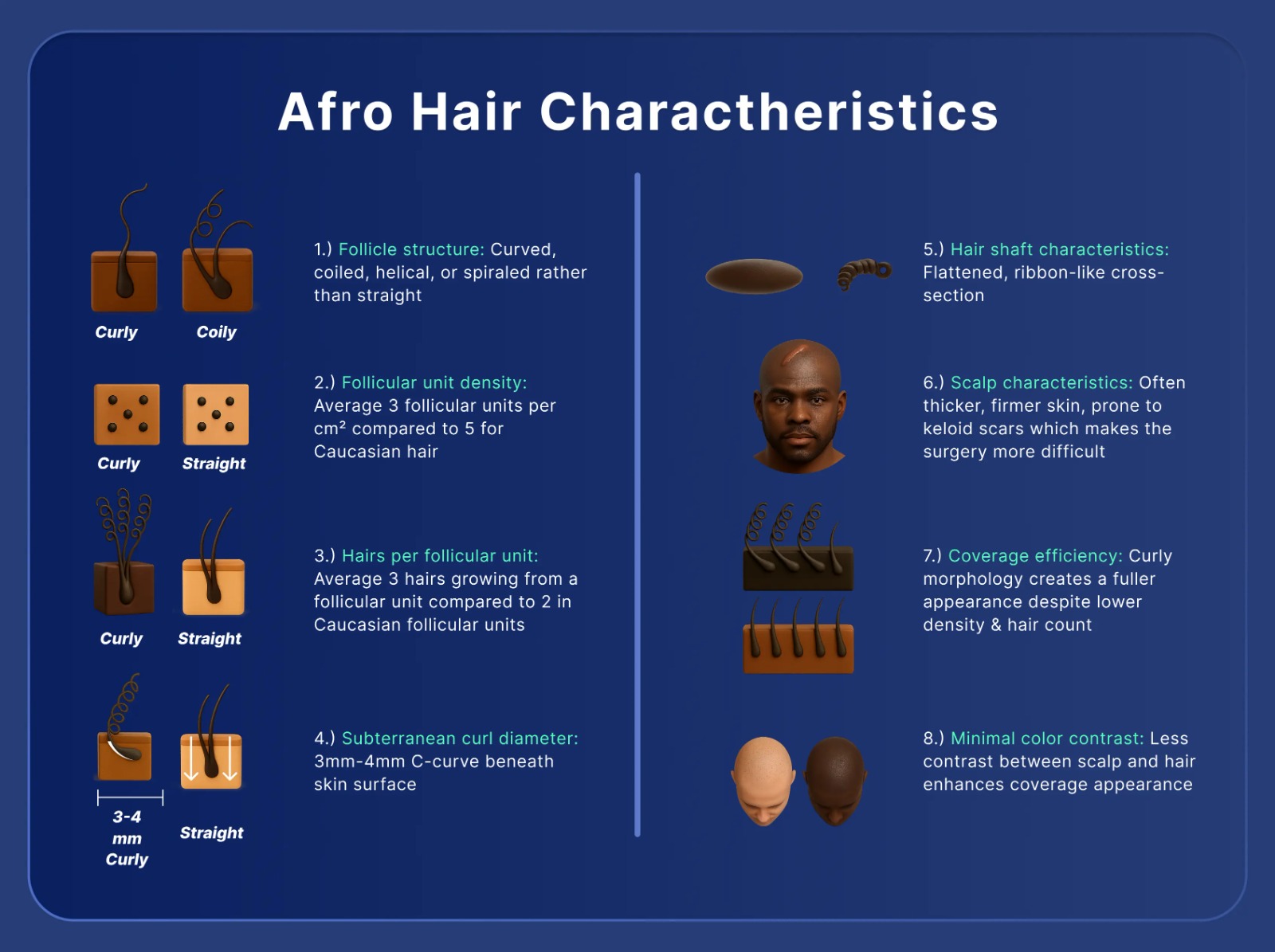
Unique characteristics include:
- Follicle structure: Curved, coiled, helical, or spiraled rather
than straight - Follicular unit density: Average 3 follicular units per cm²
compared to 5 for Caucasian hair - Hairs per follicular unit: Average 3 hairs growing from a
follicular unit compared to 2 in Caucasian follicular units - Subterranean curl diameter: 3mm-4mm C-curve beneath skin surface
- Hair shaft characteristics: Flattened, ribbon-like cross-section
- Scalp characteristics: Often thicker, firmer skin, prone to keloid
scars which makes the surgery more difficult - Coverage efficiency: Curly morphology creates a fuller appearance
despite lower density & hair count - Minimal color contrast: Less contrast between scalp and hair
enhances coverage appearance
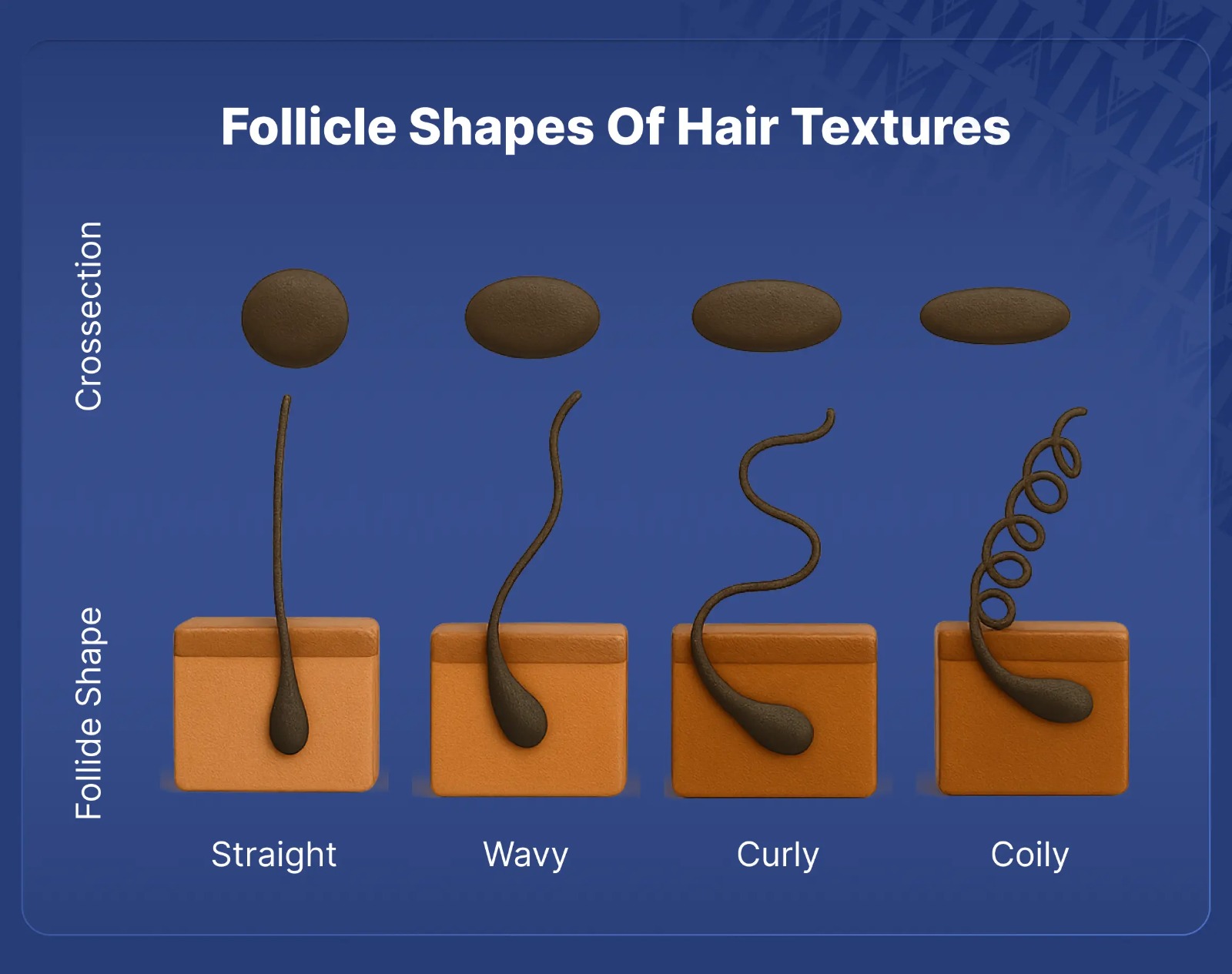
How does the curl pattern of Afro hair affect transplant results?
The curl pattern of Afro hair affects transplant results by requiring
larger extraction tools, modified techniques, and longer surgery time,
but ultimately provides excellent coverage and natural appearance due to
the curly morphology. The curved follicular structure increases
transection risk during extraction but creates superior aesthetic
density after implantation. The C-shaped subterranean curl means
surgeons cannot predict follicle direction beneath the skin surface,
necessitating specialized tools or techniques to navigate the curved
path. However, once transplanted, the curly hair texture provides more
scalp coverage per follicle than straight hair, partially compensating
for lower follicular density.
What is the difference between Afro hair and straight hair for
transplantation?
The differences between Afro hair and Caucasian hair for transplantation
are as follows:
| Afro Hair Transplant | Caucasian Hair Transplant | |
|---|---|---|
| Follicle structure | Curved/coiled/helical | Straight/wavy |
| Follicular unit density | 3 units/cm² | 5 units/cm² |
| Hairs per follicular unit | 3 follicles/unit | 2 follicles/unit |
| Transection risk | 6 up to 80% with improper technique | 5-10% |
| Keloid formation risk | 4-16% | 1-4% |
| Coverage appearance | Better coverage with less hair | Standard coverage |
| Scalp-hair color contrast | Less contrast enhances fullness | Higher contrast |
| Extraction complexity | Requires specialized tools or techniques | Standard tool and techniques are sufficient |
What should you do before Afro hair transplant?
Before Afro hair transplant, discontinue medications as directed by your
doctor, avoid smoking, alcohol, and recreational drugs for at least 2
days (preferably 2 weeks), and stop finasteride for 7 days and minoxidil
for 10 days before surgery. Consult your doctor about stopping blood
thinners 7 days before the procedure. Additionally, avoid chemical
relaxers, hair dyes, and heat treatments for at least 2 weeks before
surgery. Inform your surgeon about any personal or family history of
keloid formation to determine if test grafting is necessary.
How to find the best Afro hair transplant clinic?
When selecting an Afro hair transplant clinic, verify their specific
experience with Afro-textured hair, not just general FUE experience.
Review before/after photos of patients with similar hair types (4a, 4b,
4c), examine their transection rates for curved hair, and confirm they
use specialized equipment or technique. Choose a clinic that offers test
grafting for keloid-prone patients, provides realistic graft estimates
based on curved hair challenges, has protocols for managing keloid risk,
offers comprehensive aftercare, and maintains transparency about the
unique challenges of Afro hair transplantation.
What questions to ask during Afro hair transplant consultation?
You can ask these questions during an Afro hair transplant consultation:
“How many patients with my specific hair type have you treated?” “What
is your average transection rate for Afro-textured hair?” “Which
specialized punches and techniques do you use for curved hair?” “What is
your protocol for preventing and managing keloid formation?” “Can you
show me before/after photos of patients with hair similar to mine?” “Do
you recommend test grafting in my case?” “How many grafts can safely be
extracted from my donor area?” Buton:
64 Questions to ask your Turkish Hair Transplant Clinic</a >
What should you avoid after Afro hair transplant?
After Afro hair transplant, avoid smoking for 2 weeks, caffeine for 2
days, direct sun exposure for 2 months, and excessive salt or spice
consumption to reduce inflammation. Refrain from physical activity and
exercise for 1 month, avoid sweating for 10 days, and do not shave the
recipient area for 2 months. Keep your head elevated while sleeping
using a neck pillow, wash your head and body separately for 10 days,
wear loose button-up clothing to prevent contact with the scalp, and
avoid hair dye for 6 months.
What is the recovery process after Afro hair transplant?
The recovery process after Afro hair transplant requires minimal
activity with elevated sleep position for the first 24-48 hours. From
days 3-7, gentle washing begins and scabs start forming. By days 7-14,
scabs fall off and temporary shedding begins. Normal activities resume
between weeks 2-4. The shedding phase continues for months 1-3, followed
by new growth emergence and strengthening between months 3-12.
How long does the donor area take to heal after Afro hair transplant?
The donor area takes 7-10 days to heal after Afro hair transplant using
FUE extraction. The SRFD punch creates less-everted wounds that heal
faster through primary closure rather than secondary healing, resulting
in minimal visible scarring.
Does Afro hair transplant heal faster?
No, Afro hair transplants do not heal faster compared to hair
transplants for straight hair. However, if improper technique is used
during surgery, it can take longer to heal.
When can you get a haircut after Afro hair transplant?
You can get a haircut using scissors only at 4 weeks after Afro hair
transplant. Clippers with guards can be used on the donor area at 8
weeks, but the recipient area should not be cut with clippers until 4
months post-surgery to protect vulnerable grafts.
What are the side effects of Afro hair transplant?
The most common Afro hair transplant side effects are swelling,
discomfort, itchiness, and scabbing. Shock loss can occur in the
recipient area. Serious complications such as infections, poor graft
survival, and keloid formation are rare but more common in Afro hair
transplants than other hair types.
How long does swelling last after Afro hair transplant?
Swelling after Afro hair transplant lasts approximately 5-7 days.
Swelling may be more pronounced than in straight hair transplants due to
longer surgery time and potential for thicker skin characteristics.
Does Afro hair transplant leave scars?
Afro hair transplant leaves minimal scars in the donor area when
performed with proper FUE techniques. However, individuals of African
descent have higher keloid formation risk (4%-16%), making proper
patient and technique selection crucial.
Does Afro hair transplant cause shock loss?
Yes, Afro hair transplant can cause shock loss like any hair transplant
method. Shock loss occurs because surgical stress causes hair to enter
the catagen (shedding) phase, with hair visibly shedding 2-6 weeks
post-surgery. The roots remain healthy and regrowth begins around 120
days (4 months).
Can Afro hair transplant cause keloid scarring?
Yes, people of African descent are 4 times more likely to develop keloid
scarring than transplants in other populations, with incidence rates of
4%-16% in individuals of African descent compared to 1-4% in Caucasian
individuals. This risk makes test grafting, proper surgical technique,
and prompt post-operative care critical. Keloid formation can occur in
both donor and recipient areas. Risk factors include personal or family
history of keloids, younger age, and previous surgical sites. Preventive
measures include test grafting, immediate post-surgical prophylaxis
(topical corticosteroids, silicone gel sheeting, pressure therapy), and
avoiding areas with previous keloid formation.
When will you see Afro hair transplant results?
You will start seeing growth around 5-6 months after Afro hair
transplant and reach full results between 12-18 months. Initial growth
phase occurs during month 1, but transplanted hair sheds during months
2-3 as part of the natural process. New hair growth emerges between
months 4-6, with noticeable improvement by months 7-9 and fuller growth
developing thereafter.
Will transplanted Afro hair maintain its curl pattern?
Yes, transplanted Afro hair maintains its original curl pattern and
texture from the donor area. The follicle’s genetic characteristics,
including curl formation, remain unchanged after transplantation. The
C-shaped or helical growth pattern persists, providing the same natural
appearance as the donor hair.
How thick does transplanted Afro hair grow?
Transplanted Afro hair grows with the same thickness and diameter as the
donor hair. Grafts containing multiple follicles may appear thicker
because 2-3 hairs emerge from one location, creating more volumetric
density than single follicle grafts.
Can transplanted hair go grey after Afro hair transplant?
Yes, transplanted hair can go grey after Afro hair transplant following
the same natural aging process as indigenous hair. The hair follicle’s
pigment production decreases over time, resulting in gradual greying.
Is Afro hair transplant permanent?
Afro hair transplant results are permanent for successfully transplanted
follicles. Grafts relocated from DHT-resistant donor areas maintain
their genetic resistance to androgenetic alopecia. However, 5%-10% graft
loss is normal, and existing non-transplanted hair may continue
thinning.
Can you lose transplanted hair after Afro hair transplant?
You can lose 5%-10% of transplanted hair after Afro hair transplant,
which is normal and accounted for during surgical planning. The primary
survival rate ranges from 90%-95% depending on technique, surgeon skill,
graft handling, and individual healing factors. Additional hair loss
beyond this range likely represents indigenous hair loss rather than
transplanted follicle failure.
Can Afro hair transplant be repeated if needed?
Yes, Afro hair transplant can be repeated if sufficient donor hair
remains, results are unsatisfactory, or continued hair loss creates new
areas requiring coverage. The maximum safe extraction limit across
multiple hair transplant procedures depends on donor density and
previous extraction density.
What are the risks and complications of Afro hair transplant?
The risks and complications of Afro hair transplant include high
transection rates with improper technique (6%-80%), keloid formation
(4%-16% incidence), poor graft survival in scarred areas, infection,
excessive bleeding, postoperative pigmentation changes
(hyperpigmentation or hypopigmentation), folliculitis keloidalis, and
poor aesthetic results from inadequate density. Specific risks elevated
in Afro hair transplants compared to straight hair include higher keloid
propensity requiring test grafting and prophylactic treatment, increased
transection risk without specialized equipment, potential for
hyperpigmentation during healing, and challenges achieving adequate
density with lower baseline follicular unit counts.
What causes high transection rates in Afro hair transplant?
High transection rates in Afro hair transplant are caused by inadequate
punch diameters, incorrect extraction angles, conventional punch
designs, excessive extraction depth, and insufficient surgeon experience
with curved follicular structures. When punch diameter is smaller than
the subterranean curl width (C-curve), the punch blade cuts through the
curved follicle portion. Conventional straight punches cannot navigate
the helical path, and punching to full follicle depth without accounting
for curve direction results in follicle transection. Transection rates
of 6%-80% have been reported with standard techniques, compared to less
than 10% with specialized methods.
What are the pros and cons of Afro hair transplant?
The pros and cons of Afro hair transplant are shown in the table below:
| Advantages of Afro Hair Transplant | Disadvantages of Afro Hair Transplant |
|---|---|
| Higher follicle count per follicular unit (3 vs 2) | Requires specialized tools and techniques |
| Less color contrast enhances fullness | Higher technical difficulty and complexity |
| Can treat traction alopecia and CCCA | Gets more difficult with thicker skin and collier hair |
| Curly texture creates volume and density with less hair | Few surgeons specializing in this technique |
| Significantly lower transeciton rates with modern tools and techniques | Higher keloid formation risk |
| Best permanent hair loss solution available | Not suitable during active scalp inflammation |
Common causes of hair loss in people of African descent
Common causes of hair loss in people of African descent include
androgenetic alopecia, traction alopecia, central centrifugal
cicatricial alopecia, chemical damage, acquired trichorrhexis nodosa,
and frontal fibrosing alopecia. These conditions affect individuals of
African descent at higher rates or with distinct presentations compared
to other populations, requiring specialized treatment approaches and
consideration for hair transplantation candidacy.
The most common hair loss types in people of African descent are:
- Androgenetic alopecia (male/female pattern baldness): Affects men
in bitemporal recession and vertex patterns (Norwood scale) and
women in diffuse central thinning (Ludwig scale). Responds to
topical minoxidil, oral finasteride, and hair transplantation.
Surgical candidacy is excellent for stable patterns. - Traction alopecia: Caused by chronic tension from tight hairstyles
including braids, cornrows, weaves, extensions, ponytails, and
dreadlocks. Primarily affects frontal hairline and temporal areas.
Progresses from reversible follicular damage to permanent scarring
if traumatic styling continues. Treatment requires cessation of
traction-causing styles and hair transplantation once scarring is
established. - Central centrifugal cicatricial alopecia (CCCA): Progressive
scarring alopecia beginning at crown/vertex and spreading
centrifugally. Incidence ranges from 2.7% in African populations
to 5.6%-16.2% in African-American women. Involves lymphocytic
inflammation destroying follicles. Associated with tight
hairstyling, chemical relaxers, and genetic predisposition.
Requires suppression of inflammation with oral doxycycline,
topical clobetasol, and intralesional corticosteroids for 9-12
months before hair transplantation. - Chemical damage: Results from relaxers, straightening treatments,
and color processing that weaken hair shafts. Can trigger or
worsen CCCA. Causes hair shaft fragility, breakage, and potential
follicular destruction. Treatment requires discontinuation of
chemical treatments and adoption of protective hair care
practices. - Acquired trichorrhexis nodosa: Hair shaft disorder causing
fragility and breakage from trauma, excessive manipulation,
chemical treatments, and environmental factors. Presents as broken
hairs of varying lengths. Treatment includes discontinuing
traumatic practices, daily moisturizing with silicone products,
and protective styling. - Frontal fibrosing alopecia (FFA): Variant of lichen planopilaris
affecting frontoparietal hairline and eyebrows. Women of African
descent develop FFA at younger ages (40-42 years vs. 55.5-63 years
in Caucasians) with distinct dermoscopic features including
speckled follicular hyperpigmentation. Requires combination
therapy with topical/intralesional corticosteroids, oral
finasteride or dutasteride, and hydroxychloroquine. Hair
transplantation considered after 12+ months of disease quiescence.